
How to Become a Doll Artist

If you want to know how to become a doll artist, there is one possible warning sign. One morning you wake up at your worktable and realise that you fell asleep in a pile of absolutely essential rubbish. There are scraps of fabric, lace, clay, furry pieces, artificial eyes and an open box of beads everywhere. A sharp scalpel is lying much too close to your hand. Brushes forgotten in solvent are filling the room with their unmistakable smell. Your old jeans are covered in paint, and on the table stands a finished creature that was born sometime during the night.
After the first moment of horror, you understand the truth. This is no longer a hobby. You have become a doll artist.
What Is an Art Doll?
An art doll is an original artist created character made primarily as a work of art rather than a mass produced toy. It can be sewn, sculpted, painted, assembled or built from several techniques at once.
Some handmade art dolls are realistic. Others are whimsical, gothic, creepy cute or completely impossible to classify. What connects them is the artist's personal vision. A successful doll does not simply demonstrate technique. It feels as if it has a character, a history and a reason to exist.
This is also why handmade dolls are different from factory products. Small variations are not defects. They are part of the work.
How to Become a Doll Artist Without Losing Your Mind
1. Start Creating Before You Feel Ready
The best way to learn doll making is to make a doll. Your first creature may have strange proportions, crooked hands or an expression you did not intend. Keep going.
Every finished piece teaches something about construction, balance, sewing, sculpting, painting or materials. Technical skill grows through solving real problems.
You do not need to know your future style before you begin. Style usually appears later, after you have made enough work to notice what keeps returning.
2. Learn the Techniques You Actually Need
Doll making can combine many skills, but you do not need to master all of them at once.
· sewing and textile construction
· sculpting with clay
· wire armatures
· painting and surface finishing
· faux fur, viscose or mohair
· handmade eyes
· leather, lace and vintage fabrics
· miniature costumes and accessories
· poseable or articulated bodies
Choose techniques that help you create the characters you imagine. The purpose of learning is not to collect skills. It is to give your ideas a physical form.
3. Collect Materials and References
This stage happens almost automatically. Your computer begins filling with photographs of faces, clothes, furniture, jewellery, animals and strange situations. You notice how someone wrinkles their nose and immediately wonder whether the same expression would work on a new doll.
Your home also changes. Boxes appear. Then more boxes. They contain fabric, feathers, beads, wire, plastic pieces, leather scraps, eyes and tiny metal objects that make no sense to anyone except you.
Eventually there are also boxes containing other boxes, because finished creations need somewhere to live before they travel to collectors. This is not necessarily a problem. It is a studio ecosystem.
4. Find Your Own Style
A recognisable style is rarely invented in one afternoon. It grows from repeated choices. Maybe you keep returning to long noses, tired eyes, exaggerated ears, antique fabrics or slightly unsettling smiles. Maybe your characters are dark but gentle. Maybe they are funny and uncomfortable at the same time.
Pay attention to those repetitions.
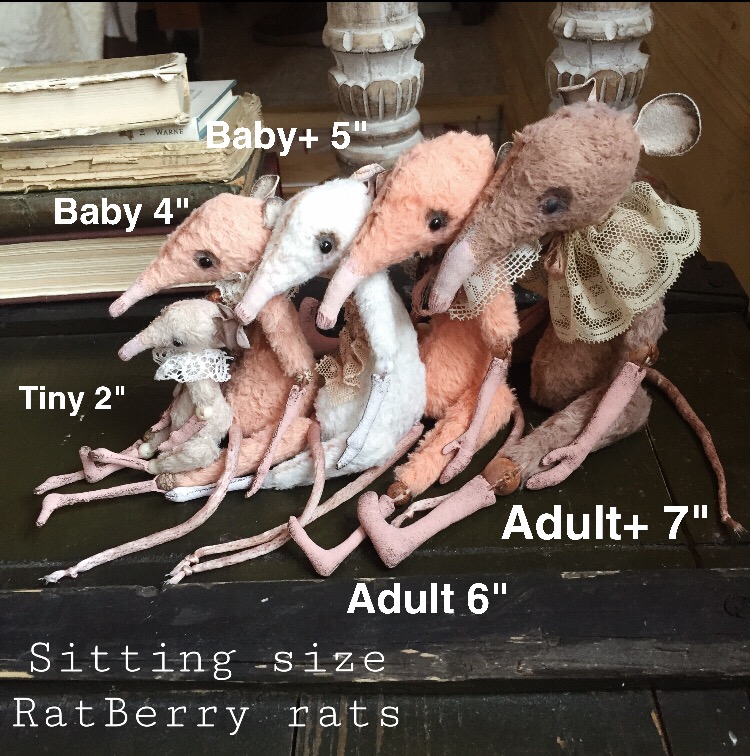
RatBerry grew from textile construction, sculpture, poseable bodies and a gentle gothic atmosphere. You can explore different characters in the RatBerry catalog, including rats, bats, ravens, rabbits and other creatures.
The point is not to become similar to another artist. The point is to make enough work for your own visual language to become obvious.
5. Accept That It May Become an Obsession
At some point, ordinary life begins competing with unfinished creatures. You may sit down for ten minutes and discover that it is three in the morning. You may enter a fabric shop for one thing and leave with six materials for characters that do not exist yet.
When talking to normal people, you learn to pretend that you are interested in completely ordinary subjects while part of your brain is thinking about how to reproduce someone's nose, hands or posture in a doll.
There is no reliable cure for this condition. Fortunately, it can become a serious artistic practice.
What Does a Doll Artist Actually Need?
You do not need an art degree, a perfect studio or expensive equipment to begin. You need curiosity, patience and enough persistence to finish things.
Formal education can help with anatomy, sculpture, painting and design, but many doll artists are self taught. They learn through books, workshops, tutorials, experiments and mistakes. What matters is repetition. Each finished character creates a foundation for the next one.
A good portfolio also becomes important. Photograph your work clearly. Show full characters as well as faces, textures, hands, clothing and construction details. A portfolio helps collectors understand your artistic language.
If you want to see how a consistent body of work develops over time, browse the RatBerry handmade rat dolls and the Gothic Art collection.
From Handmade Dolls to Collectible Art
When a doll develops a strong identity, it can become more than a decorative object. Collectors often respond to originality, craftsmanship, character and recognisable style. A one of a kind art doll may be especially attractive because the exact combination of expression, materials and details exists only once.
This does not mean every doll has to be technically perfect. Sometimes the memorable part is the strange smile, the asymmetry, the worn fabric or the feeling that the creature has already lived somewhere before it reached you.
The strongest collectible art dolls usually belong to a coherent artistic world. They look different from one another, but they still feel related.
Conclusion
You become a doll artist by making dolls. Learn techniques when you need them. Experiment with materials. Keep references. Finish imperfect work. Notice the strange ideas that keep returning and follow them.
One day your computer may be full of faces, your apartment may be full of boxes, and your notebook may contain more unfinished creatures than practical plans.
Your personal life may occasionally suffer.
But somewhere on your table there will be a character that did not exist before you imagined it. That is probably worth the mess.
FAQ
Do I need art school to become a doll artist?
No. Formal education can help, but many doll artists are self taught. Consistent practice and experimentation are more important.
What materials are used for art dolls?
Common materials include fabric, clay, wire, faux fur, viscose, mohair, leather, lace, beads and handmade or glass eyes.
What is an OOAK art doll?
OOAK means one of a kind. It is an individual handmade piece created as a unique artwork rather than a mass produced item.
How do I develop my own doll making style?
Create many different characters and notice which proportions, expressions, materials and moods keep appearing naturally in your work.
Can handmade art dolls become collectible?
Yes. Collectors often value originality, craftsmanship, strong character design and a recognisable artistic identity.